
Notre Dame Paris: The 850-Year Story of the Cathedral That Refused to Die
Notre Dame Paris: The 850-Year Story of the Cathedral That Refused to Die
Eight hundred and fifty years. A cathedral built across two centuries by hands that would never see it finished. A building that survived a Revolution that tried to dismantle it stone by stone, an actual public sale where it was almost sold off for scrap, a 19th-century plan to demolish it for being too ugly, a Nazi occupation, and a fire so hot the lead from its roof melted into the sky.
And here it stands. Restored. Reopened. Ringing.
If you walk up to Notre Dame Paris today, you're not looking at an old building. You're looking at the world's most successful comeback story, in stone.
I've guided thousands of visitors around this cathedral. This is the version of the story I wish every visitor knew before they arrived — the one I tell my tour groups, with the legends, the near-disasters, and the small details most guidebooks skip.
1163: A Bishop With a Vision (And a King to Fund It)
Notre Dame's story begins with one man and one ambition.
Maurice de Sully had become Bishop of Paris in 1160. The cathedral that stood on the Île de la Cité at that moment was the old Cathedral of Saint-Étienne — Saint Stephen, named after the first Christian martyr. It was Romanesque, low, dark, and by the standards of 12th-century Paris, already feeling old.
Maurice de Sully wanted something different. He wanted a cathedral that rose. Tall, narrow, full of light — the architectural language we now call Gothic, which was only just being invented at Saint-Denis a few kilometres north. He had the connections (King Louis VII was a friend), the funding, and the ambition.
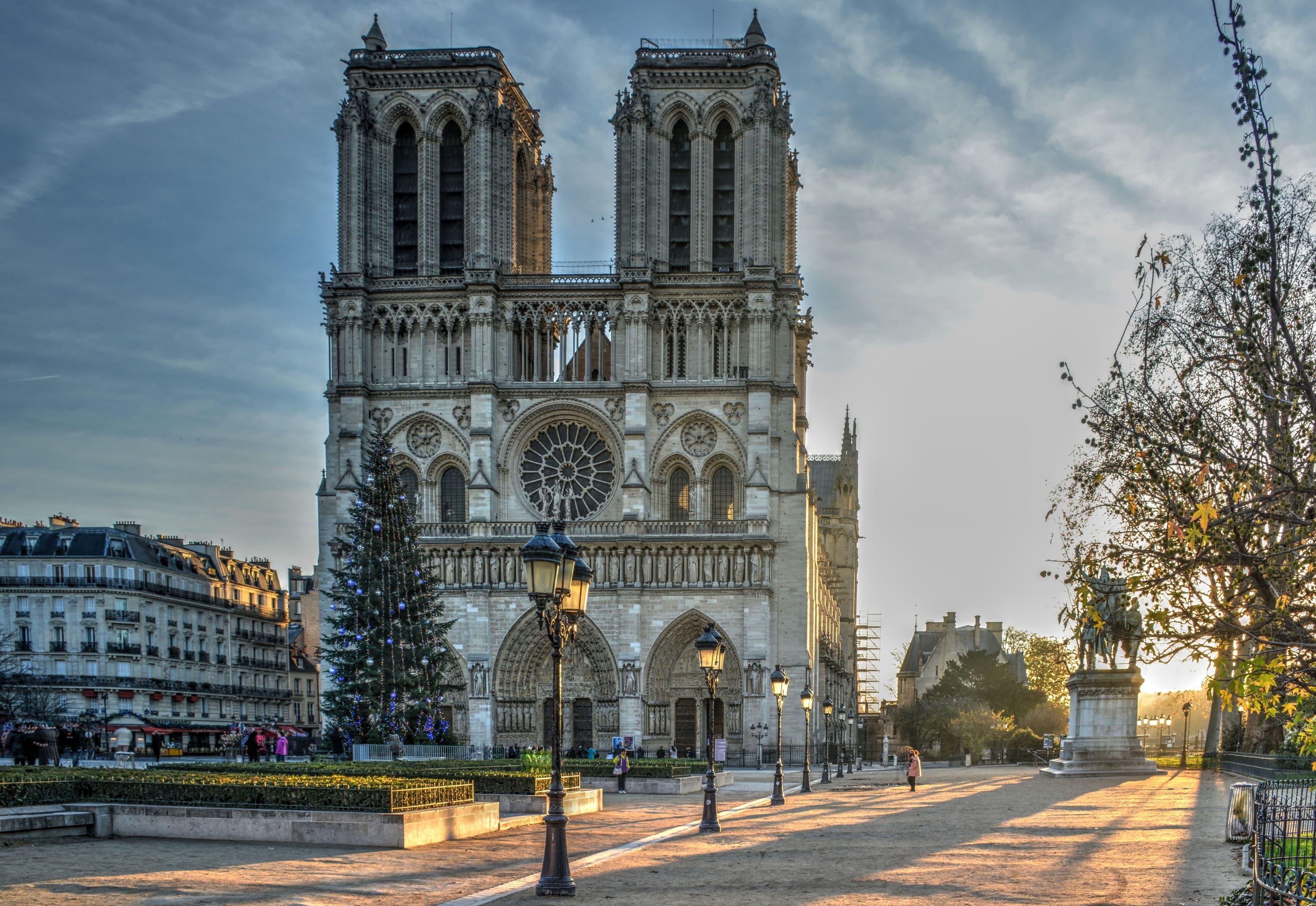
In 1163, the first stone was laid. The choir was finished by 1182. The nave by around 1250. The west facade with its two great towers — the silhouette you recognise — was largely complete by 1260. Modifications, chapels, and refinements continued until roughly 1345.
That's nearly 200 years of construction. Generations of stonemasons were born, worked, and died on this single site. The men who carved the foundations never lived to see the rose windows. The men who built the rose windows never knew the people who designed the foundations.
Flying Buttresses: The Engineering Magic Trick
Here's the problem Maurice de Sully handed his architects: he wanted walls that were impossibly tall and impossibly thin. Walls full of stained glass instead of stone. A cathedral that felt like it was lifting off the ground.
There was just one issue. Stone walls that tall and that thin would collapse. The weight of the roof would push them outward.
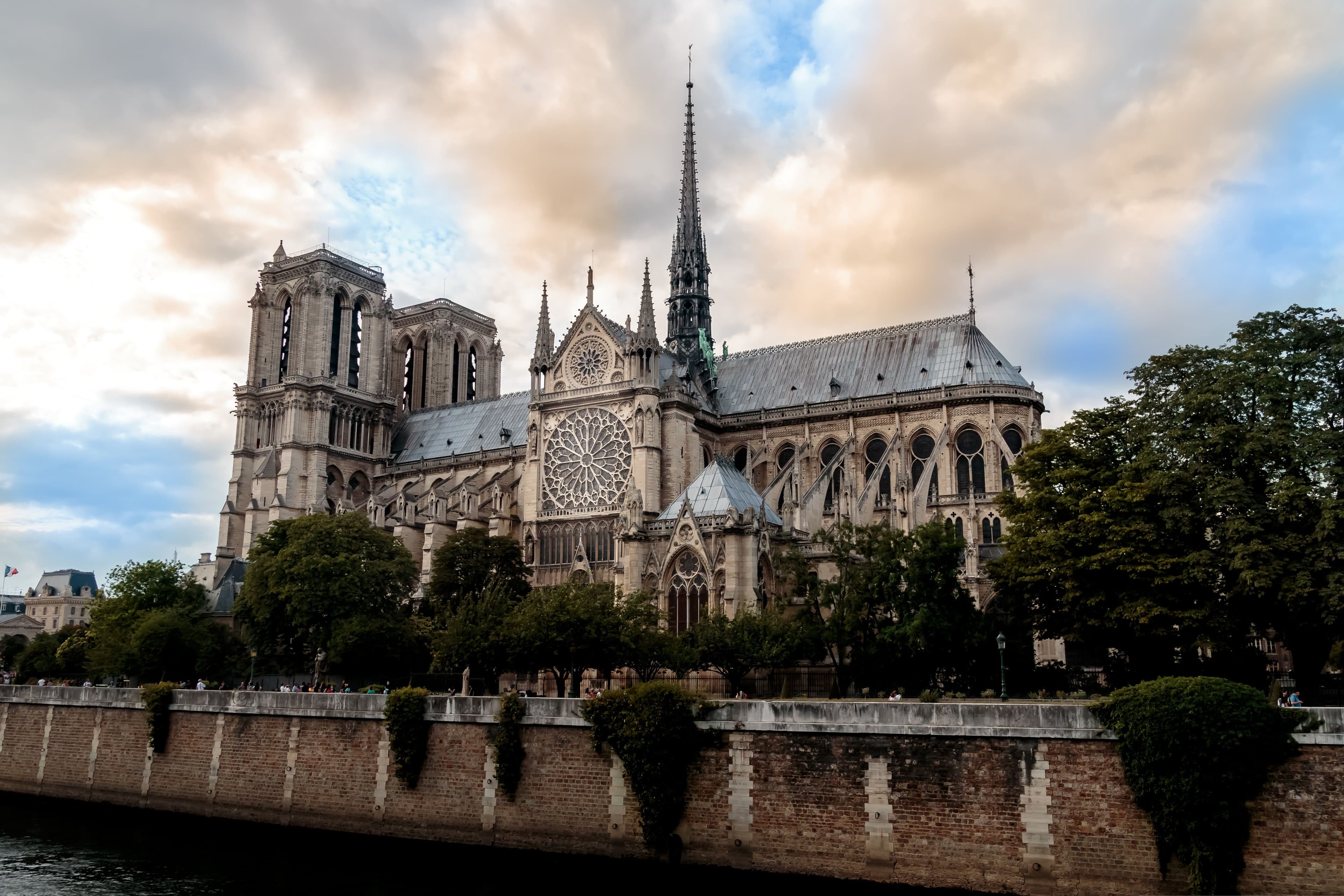
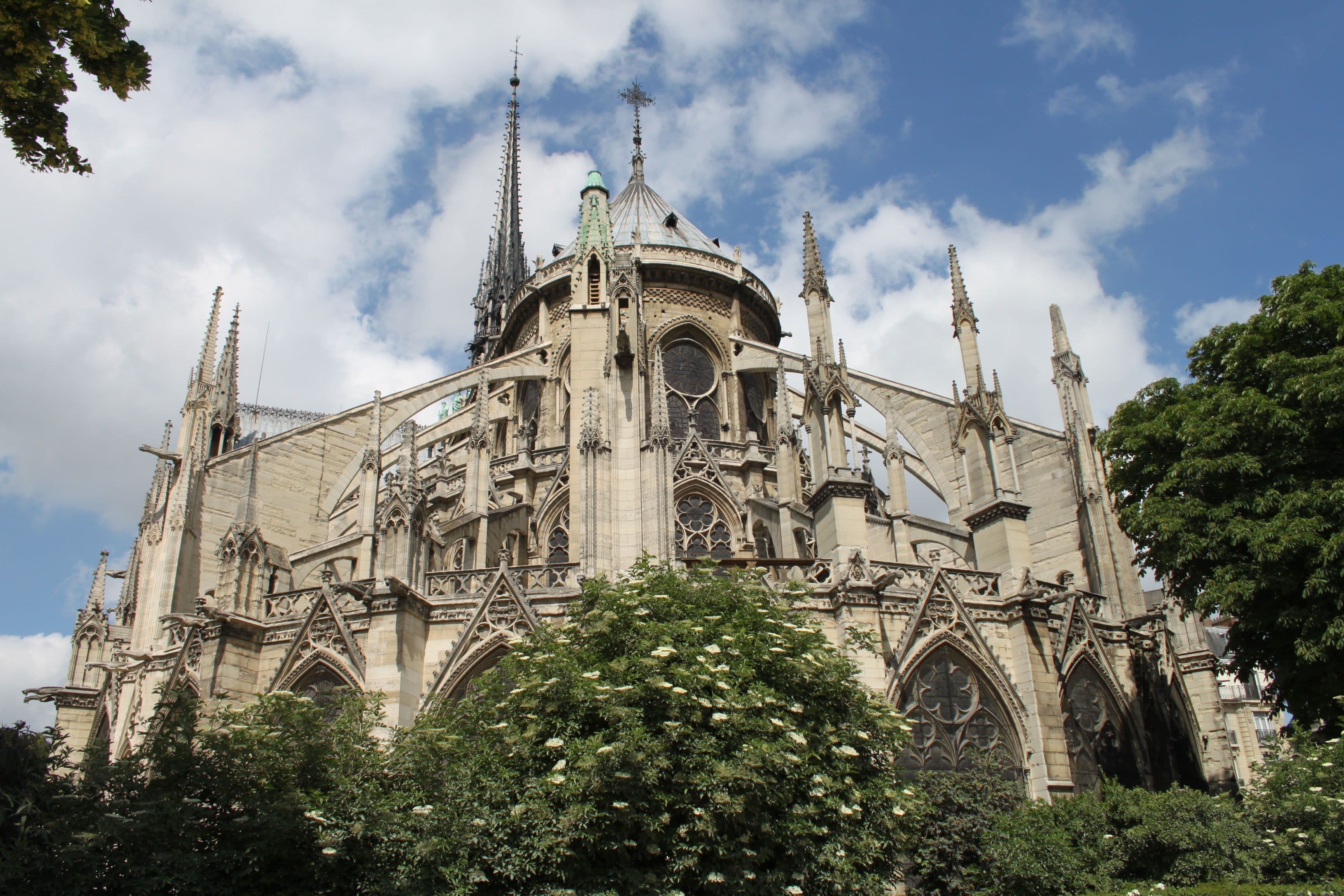
The solution was the flying buttress — and Notre Dame was among the very first buildings in the world to use them on this scale. A flying buttress is essentially a stone arm that reaches out from the wall, catches the outward push of the roof, and redirects it downward into a freestanding column. The wall stays straight. The roof stays up. The glass stays intact.
Walk around the back of Notre Dame — the eastern side, behind the cathedral — and look up. You'll see them: dozens of stone arches reaching out from the walls like the ribs of an enormous skeleton. This is one of the most photographed views in Paris, and most visitors don't realise they're looking at one of medieval Europe's most important engineering breakthroughs.
And there's a hidden function most people miss: the flying buttresses are also the cathedral's drainage system. Rain falls on the roof, flows down channels carved into the top of each buttress, and exits the building through carved stone spouts on the ends — the gargoyles.
The 28 Statues That Lost Their Heads
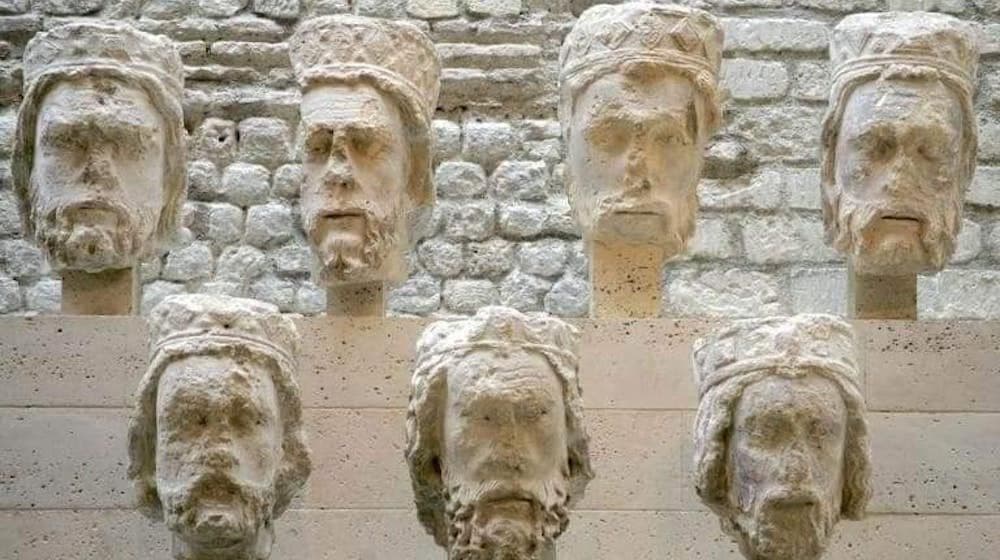
Now look at the west facade — the front of the cathedral, the side with the three big portals. Above the doors, running across the entire width of the building, you'll see a row of 28 statues of kings.
Most visitors assume they're kings of France. They're not. They're the 28 Kings of Judah — biblical ancestors of Christ, mentioned in the Old Testament. They've been there since around 1230.
That mistake — confusing them for French kings — almost destroyed them.
1789: The Revolution Comes for the Cathedral
When the French Revolution erupted, religion became the enemy. The Catholic Church was seen as the partner of the monarchy, a pillar of the old order that had to be torn down. Churches were stripped, looted, and converted. Notre Dame was officially renamed the "Temple of Reason" in 1793 and rededicated to the Cult of Reason — a state-sponsored atheist replacement for Catholicism. Later it was rebranded again as the Temple of the Supreme Being. For a while, it was used as a wine warehouse.
In 1793, the revolutionaries turned to the facade. They looked up at those 28 statues, saw crowns, and assumed they were French kings. They climbed up, pulled them down with ropes, and decapitated them in the square in front of the cathedral. The heads were left where they fell.
Twenty-eight statues. Twenty-eight beheadings — performed in the same square where, just streets away, real human beings were being guillotined.
1977: The Heads Come Back
For 184 years, no one knew what had happened to the heads.
Then, in 1977, construction workers excavating beneath an old mansion in the 9th arrondissement — the Hôtel Moreau, behind a wall — found a hidden cache. Twenty-one of the original heads, buried by a royalist sympathiser in the 1790s who couldn't bear to see them destroyed. He had hidden them, hoping someone would find them later.
Someone did. They are now on display at the Musée de Cluny, the Museum of the Middle Ages, a fifteen-minute walk from Notre Dame. If you have an extra hour in Paris, go see them. Standing in front of a 13th-century stone face that was buried in someone's backyard for two centuries to save it from a mob is the kind of Paris moment most tourists miss.
The 28 statues you see on the facade today are 19th-century replacements. The originals are at Cluny. The story of who carved them, who beheaded them, who hid them, and who found them spans 750 years.
The Bell That Refused to Die
Look up at the two great west towers. They are 69 metres tall, identical at a glance, and home to some of the oldest bells in Europe.
Before the Revolution, Notre Dame had 20 bells. By the end of the Revolution, it had one.
Emmanuel: The Survivor
The Revolutionaries melted down nineteen of Notre Dame's bells. The bronze was used to cast cannon for the new Republic's armies. Only one bell escaped: Emmanuel, the largest of all, hanging in the south tower.
Why was Emmanuel spared? Officially, the revolutionaries said it was preserved out of respect for cultural heritage. Unofficially, it weighs 13 tonnes — including a 500-kilo clapper alone — and they probably couldn't get it down.
Emmanuel was cast in 1681 and renamed by King Louis XIV in 1683. It rings in F-sharp, and it's considered one of the most beautiful-sounding bells in Europe. It's also the bell associated with Quasimodo in Victor Hugo's novel — the bell the hunchback bell-ringer fell in love with.
You won't hear Emmanuel often. It only rings for major events: Christmas, Easter, the death of a Pope, the day after a French president dies, and historical moments of national significance. After the September 11 attacks, Emmanuel rang for the people of New York. The day Notre Dame reopened after the fire, on December 7, 2024 — Emmanuel rang.
Marie, and the Bells of 2013
The other bell that hung beside Emmanuel before the Revolution was called Marie — named for the Virgin Mary. The original Marie was melted down. A replacement was cast in 1856, but the metal quality was poor and the sound never matched Emmanuel.
So in 2013, for the cathedral's 850th anniversary, eight new bells were cast at the Cornille-Havard foundry in Normandy using medieval techniques — and a new Marie, 6.6 tonnes, was cast at the Royal Eijsbouts foundry in the Netherlands. All eight new bells live in the north tower today. Marie now hangs in the south tower beside Emmanuel.
If you visit Notre Dame on a major feast day — Easter Sunday, Christmas Eve, the Assumption (August 15) — and stand outside at the right moment, you can hear all ten ring at once for the first time since 1791. It is the sound that returned to Paris after two hundred years of silence.
On Sale: How Notre Dame Almost Became Building Materials
This is the part of Notre Dame's history that most guidebooks gloss over. It's also the part you need to understand to make sense of everything that came after.
When the Revolution ended in 1799, Notre Dame was a wreck. Its bells were gone. Its statues had been smashed. Its altars had been replaced with allegorical statues of "Liberty." The interior had served as a wine warehouse. And legally, it no longer belonged to the Church — in 1789 the Revolution had seized all church property and made it the property of the nation.
Across France, that property was being sold off. Twenty-two churches and fifty-one convents in Paris alone were demolished between 1790 and 1799, bought by real estate speculators who tore them down and sold the stone, lead, and timber for new construction. The phrase "PROPRIÉTÉ NATIONALE À VENDRE" — "National Property for Sale" — was painted on the walls of these doomed buildings.
Notre Dame was painted with the same words. It went up for auction. A building-materials merchant bought it, planning to strip it for parts.
That phrase — "National Property for Sale" — could still be read on Notre Dame's facade in 1833, more than thirty years after the cathedral was saved.
Napoleon's Save
In November 1799, Napoleon Bonaparte seized power in a bloodless coup. "We have reached the end of the Revolution's narrative," he announced. "Now we must govern, not philosophize."
Part of governing meant making peace with the Catholic Church — not because Napoleon was personally religious (he wasn't particularly), but because most French people still were, and the Revolution's attack on the Church had created instability he wanted to end.
In 1801, Napoleon negotiated the Concordat with Pope Pius VII. The agreement re-established Catholic worship in France, restored church buildings to religious use (though not ownership), and most importantly for our story — it annulled the sale of Notre Dame.
The cathedral was saved. The building-materials merchant lost his prize. On April 18, 1802 — Easter Sunday — bells rang from Notre Dame for the first time since the Revolution. The building was hastily decorated to hide the damage. Napoleon attended the Easter Mass. The Concordat was solemnly proclaimed.
1830: They Tried to Demolish It Again
Saving Notre Dame in 1801 didn't solve its problems. The building was still falling apart. By the 1820s, parts of the roof were rotting, the spire (the medieval one, taken down between 1786 and 1792 because it was unstable) had not been replaced, the sculpture was crumbling, and the cathedral was widely considered an eyesore — an unfashionable Gothic relic in an age that preferred Neoclassical architecture.
Then came the July Revolution of 1830. Rioters destroyed many of Notre Dame's stained glass windows and set fire to the neighbouring Archbishop's Palace. In the aftermath, Parisian authorities seriously discussed demolishing the entire cathedral. Again.
Victor Hugo Saves Notre Dame (Again)
In 1831, a 29-year-old French writer named Victor Hugo published a novel called Notre-Dame de Paris.
You probably know it by its English title: The Hunchback of Notre-Dame.
The book is best known today for its tragic love story — the hunchbacked bell-ringer Quasimodo, the gypsy dancer Esmeralda, the obsessed Archdeacon Frollo. But that's not actually what Victor Hugo was writing about. The real protagonist of the novel is the cathedral itself. Hugo wrote the book as a love letter and a desperate political alarm. France was destroying its medieval heritage. Notre Dame was about to be torn down. He needed to stop it.
The novel was a phenomenon. It swept Paris, then France, then Europe. People who had ignored Notre Dame for fifty years suddenly came to look at it. A national movement to save the cathedral began. The demolition plans were dropped. In 1842 the Minister of Justice and Worship ordered a major restoration. In 1844, architects Eugène Viollet-le-Duc and Jean-Baptiste Lassus won the commission.
“"Notre Dame de Paris has refused to die. Again."”
Eugène Viollet-le-Duc: The Architect Who Reinvented Notre Dame
If Victor Hugo saved Notre Dame's life, Eugène Viollet-le-Duc gave it the face we know today.
Viollet-le-Duc was 30 years old when he was given the commission. Lassus died in 1857 and Viollet-le-Duc took over alone. He spent the next 20 years restoring — and significantly reinventing — the cathedral.
He didn't just repair what was damaged. He added. He invented. He decided what the cathedral should look like.
Three of his most famous additions:
1. The Spire (Flèche)
The original medieval spire was a small wooden flèche built around 1250. After centuries of wind damage it was unstable, and it was dismantled between 1786 and 1792. Notre Dame went without a central spire for nearly seventy years.
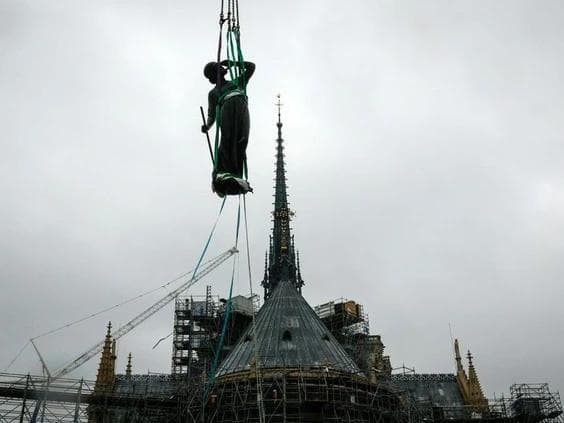
Viollet-le-Duc designed a replacement that was triple the height of the original — 96 metres from the ground, with an oak frame, 250 tonnes of lead covering, and a 750-tonne total weight. He surrounded its base with 16 copper statues: the 12 Apostles and the 4 symbols of the Evangelists. All of them face outward, toward Paris.
All of them except one.
2. The Chimeras (Not Gargoyles)
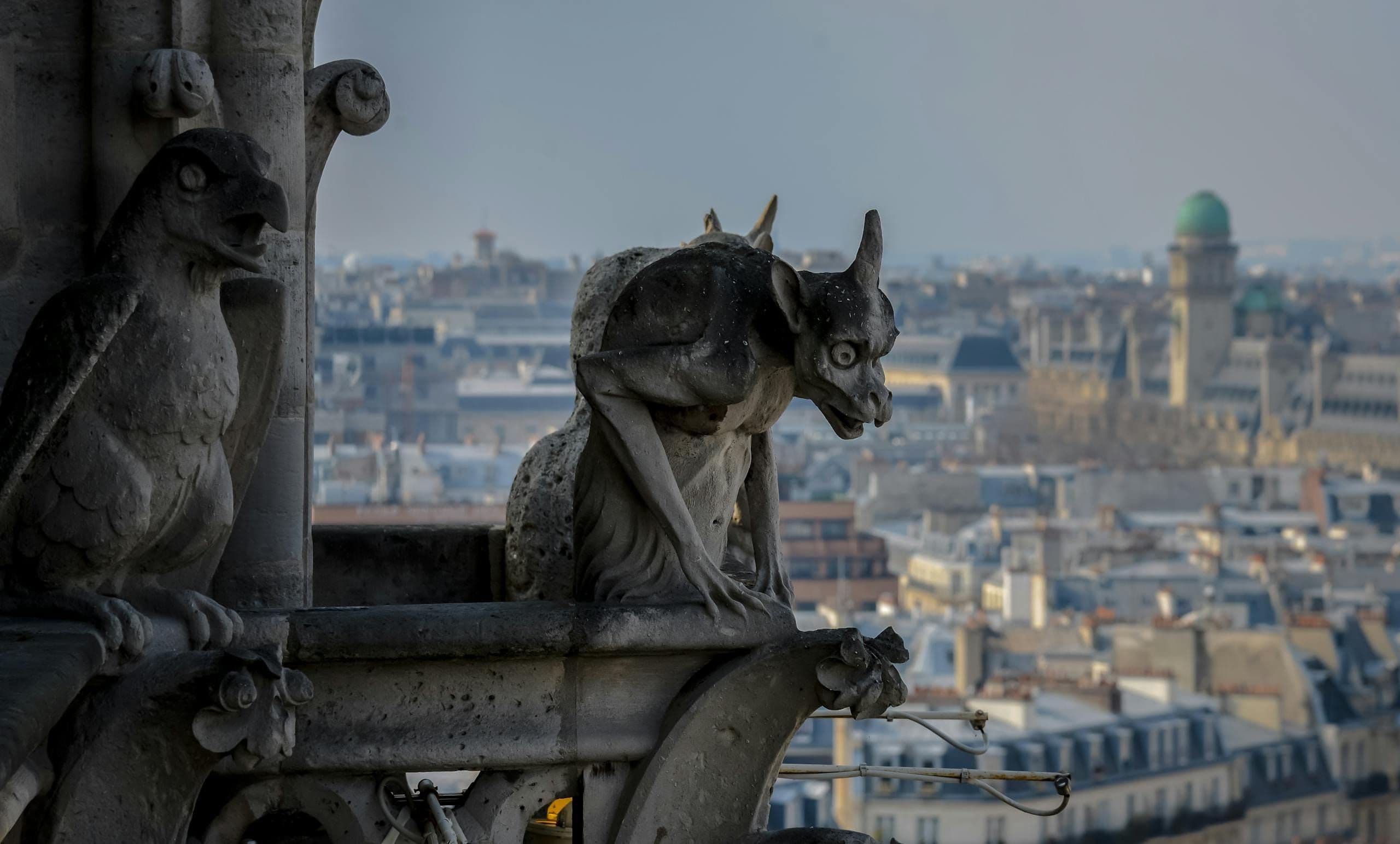
Climb the towers today and walk along the high balustrade between them, and you'll see them: dozens of grotesque stone creatures, leering out over Paris. Demons, monsters, monkeys, a strange bird-eating fiend with its tongue out. The most famous is called Le Stryge — "The Vampire" — chin resting on his hands, gazing eternally over the city.
None of them are medieval. Viollet-le-Duc invented them in the 1850s, inspired in part by Victor Hugo's novel. They serve no architectural function. They drain no water. They exist purely for atmosphere.
When he installed them, the public was furious. Catholic critics called them blasphemous. Architectural purists called them historically inaccurate. Why put demonic creatures on a holy building?
Viollet-le-Duc's answer was clever, and very French: they are guardians. They look like evil so that real evil, passing by, will think the cathedral is already occupied — and pass on.
3. The Rooster on Top of the Spire
Every Viollet-le-Duc restoration ended with the same signature: a rooster placed on top of the highest point. The rooster (le coq) is the symbol of France — and at Notre Dame, Viollet-le-Duc placed one on the very tip of the 96-metre spire, the highest point of the cathedral.
But this was not an ordinary rooster. Inside it, sealed within the copper body, were three Christian relics:
1. A fragment of the Crown of Thorns (believed to have been worn by Christ at the Crucifixion)
2. A relic of Saint Denis (the first Bishop of Paris, decapitated by the Romans on the hill now called Montmartre in the 3rd century)
3. A relic of Saint Geneviève (the patron saint of Paris, who according to legend saved the city from Attila the Hun in the 5th century by leading Parisians in prayer)
The rooster was effectively a flying reliquary. As long as it stood on the spire, three of the most sacred objects in French Catholic history flew above Paris.
The Night the Rooster Fell
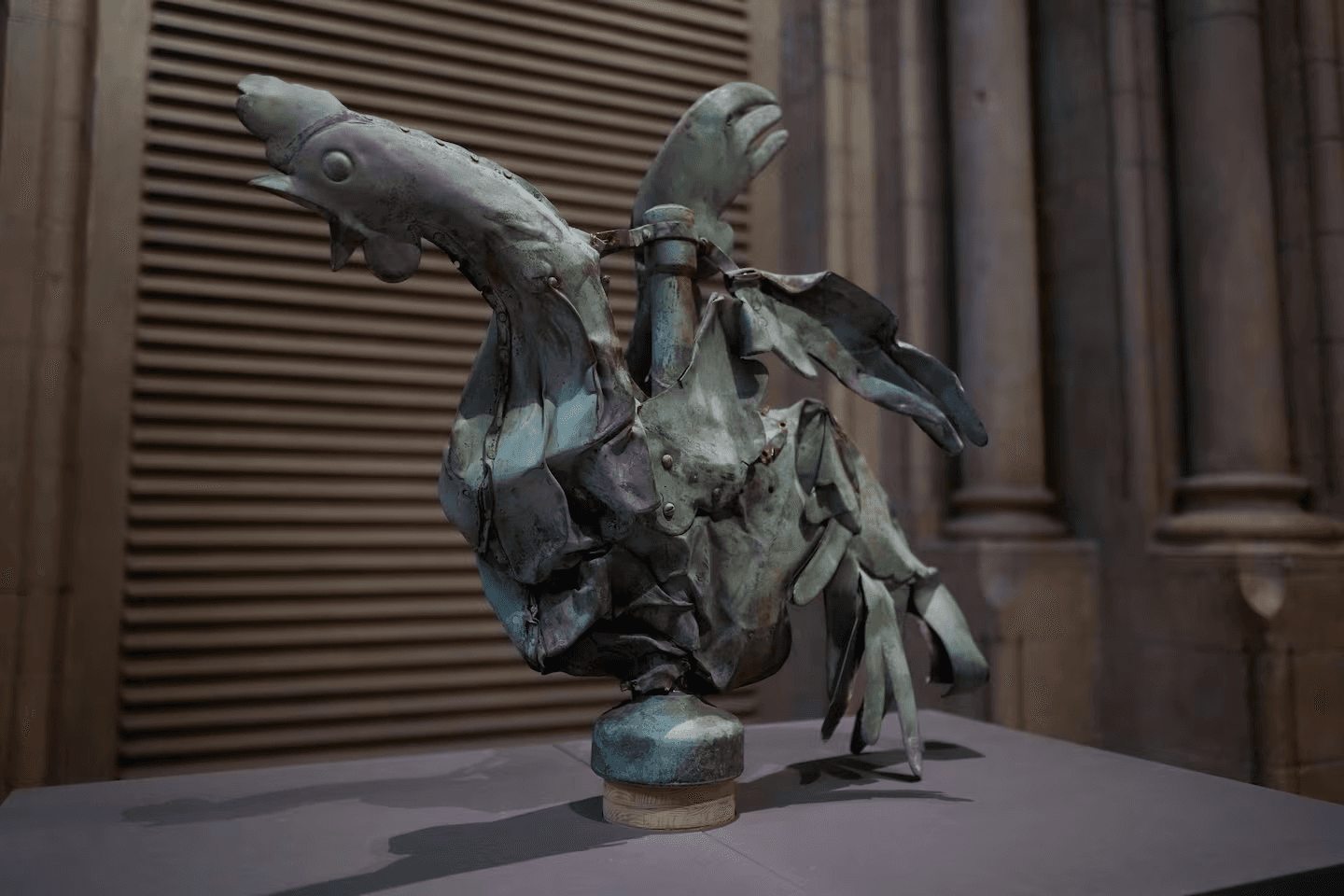
When the spire collapsed in flames on April 15, 2019, observers assumed the rooster was destroyed.
Two days later, on April 17, a worker sifting through the debris found a battered, charred lump of copper. It was the rooster — bent, dented, but intact. The three relics inside had survived.
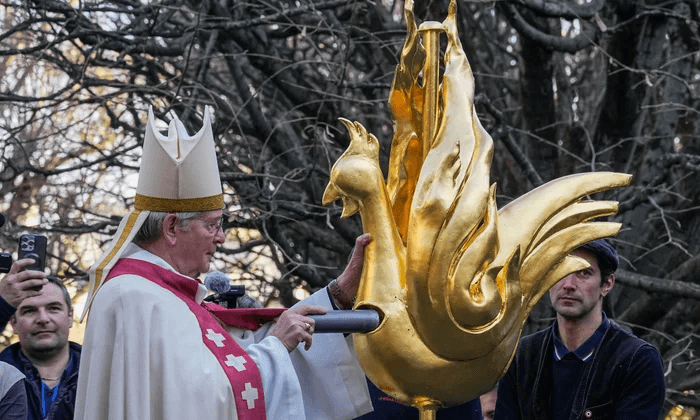
They are still inside. When the new spire was completed in December 2023, a new rooster — copper coated in gold leaf — was placed on top. The three original relics were transferred into it, along with one new addition: a parchment listing the names of every worker who had rebuilt the cathedral after the fire. Two thousand and four names, sealed inside the rooster, flying over Paris.
April 15, 2019: The Day the World Watched Notre Dame Burn
It was a Monday during Holy Week. Inside the cathedral, evening Mass had just begun.
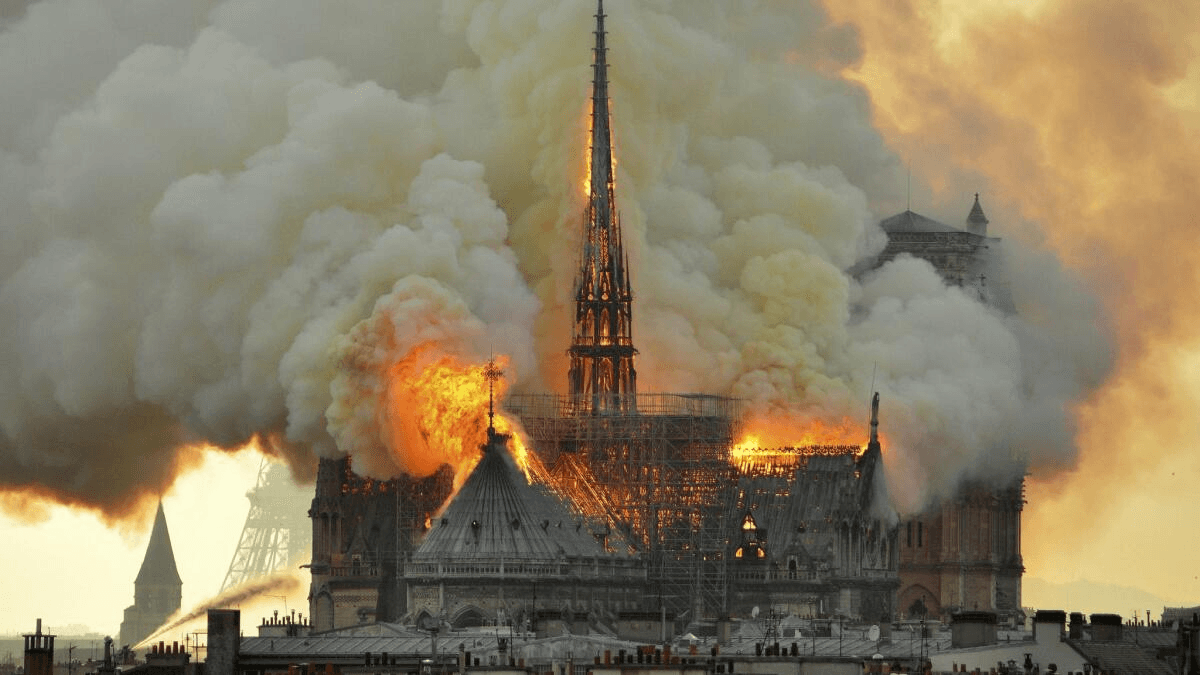
At 6:18 p.m., the fire alarm sounded.
The security guard monitoring the system was three days into his job and working a double shift because his replacement had not turned up. He looked at the alarm panel — and misread it. He sent a colleague to check the attic of the sacristy, an adjacent building. The colleague found nothing. They radioed "all clear."
They had been looking in the wrong place.
By the time the mistake was identified, twenty-five minutes had passed. The guard climbed the 300 stairs to the real attic — Notre Dame's medieval timber roof, known as la forêt, "the forest," because the oak trees that made it had been felled in the 12th century — and found the fire already raging.
At 6:51 p.m., the fire brigade was finally called. Firefighters arrived ten minutes later. By then the roof was an inferno burning at 800°C.
Why The Roof Was So Dangerous
Notre Dame's roof was made of oak — 1,300 13th-century oak beams covering an area of 100 metres long by 13 metres wide. Over the timber lay 210 tonnes of lead sheeting, which protected the roof from rain.
Lead melts at 327°C. The fire was burning at over twice that. As the lead melted, it released toxic vapour into the air around the cathedral. Firefighters trying to enter the building had to wait for specialist breathing equipment — losing another critical 30 minutes.
When they finally went in, they faced an impossible choice. The high-pressure water hoses they had brought would tear the limestone interior to pieces — Notre Dame is 800 years old; the medieval walls are fragile. They had to switch to low-pressure water, which would not save the roof but might save the stone walls and the irreplaceable artwork inside.
The Human Chain
As the fire raged above, dozens of firefighters, priests, and volunteers formed a human chain through the cathedral. They passed paintings, relics, and treasures from inside the burning building to safety on the parvis outside.
The Crown of Thorns — the central relic, brought from Constantinople by King Louis IX in 1239 — was rescued by Father Jean-Marc Fournier, the chaplain of the Paris Fire Brigade, who walked into the cathedral while the roof was on fire above him.
The 16th-century pipe organ, the three medieval rose windows, the great altar, the Pietà sculpture, and the bells were all saved.
It took 17 hours to extinguish the fire. By morning, the roof was gone. The spire had collapsed at 7:50 p.m., punching a hole through the stone vaulted ceiling and sending a fireball through the attic. Most of the wooden roof structure was destroyed. The walls, the towers, the rose windows, and almost all the moveable art survived.
Three emergency workers were injured. No one died.
The Lead
In the months after the fire, a quieter tragedy emerged. The 210 tonnes of melted lead had not just evaporated. It had settled — on the streets, on the buildings nearby, and inside the cathedral itself. Paris had a lead contamination problem.
Workers on the restoration site — and some of the firefighters who had been at Notre Dame on April 15 — later showed elevated blood lead levels. The cathedral became one of the most carefully monitored lead-decontamination zones in the world. Workers wore full protective suits. The street drains around the building were sealed.
This is why, when you visit Notre Dame today, the surrounding stones and pavements are noticeably cleaner than other parts of central Paris. They have been scrubbed, repeatedly, of one of the most invisible legacies of the fire.
Five Years to Resurrect a Cathedral
The day after the fire, President Emmanuel Macron stood in front of the ruined cathedral and promised it would be rebuilt within five years.
Almost no one believed him. The damage was catastrophic. The roof was gone. The spire was gone. There were no surviving blueprints of the medieval frame. The traditional carpentry skills needed to rebuild it had been nearly extinct for centuries.
And yet.
The Money
Within a week, donations from 340,000 individuals and businesses across 150 countries had reached over €840 million. France's three largest luxury houses — Bernard Arnault's LVMH (Louis Vuitton, Dior), François Pinault's Kering (Gucci, Saint Laurent), and the Bettencourt-Meyers family (L'Oréal) — collectively pledged over €500 million.
It was the largest cultural fundraising effort in modern history.
The Wood
Notre Dame's medieval roof — la forêt — had been built from oak trees felled in the 1160s, when each tree was already over 100 years old. To rebuild it authentically, France needed roughly 1,200 mature oak trees, each at least 150 to 200 years old, with very specific diameter and length characteristics.
Public forests, private estates, and family woodlands across all of France contributed. Aristocratic families donated trees from estates that had been in their family since before the Revolution. Small farmers contributed single oaks from their fields. By the end of 2021, more than 1,000 oaks had been selected, felled, and sent for drying.
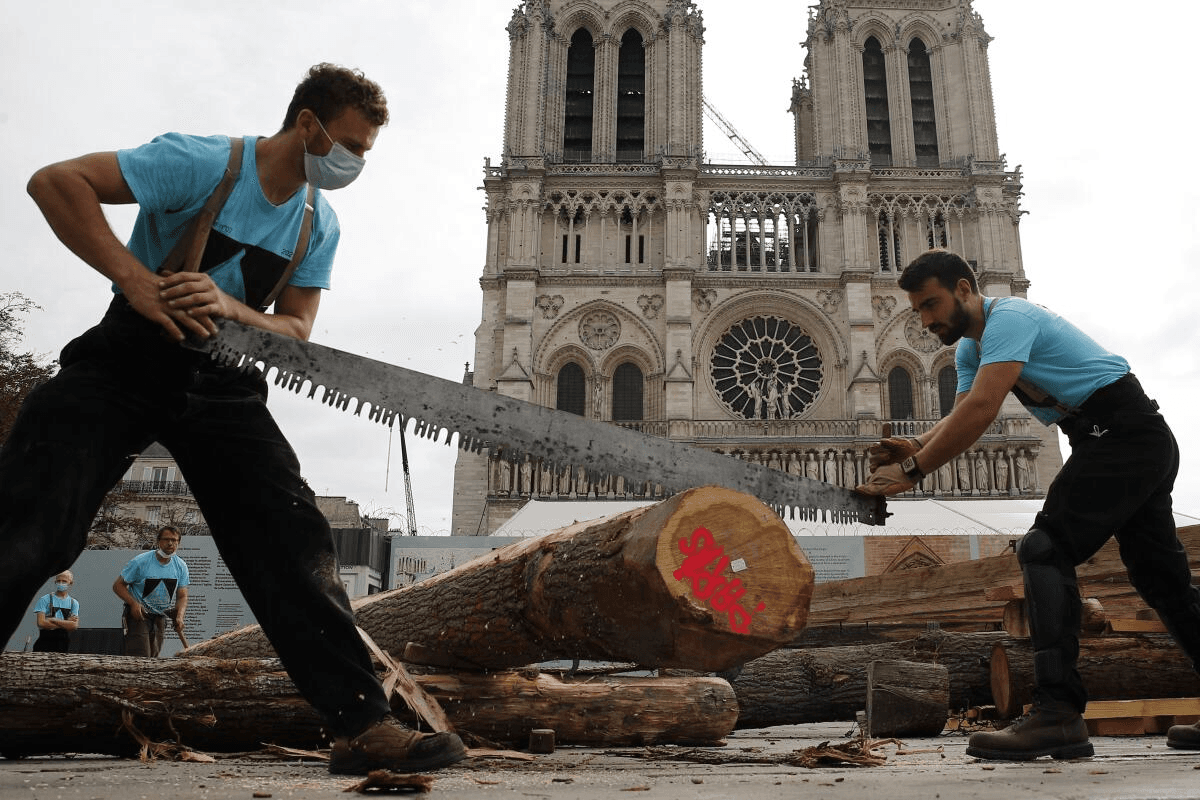
They were then shaped — by hand, using medieval-pattern axes — by carpenters trained in techniques that had not been used commercially in France for over 300 years.
The Americans Who Helped
This part of the story is less well known. When France was looking for carpenters who could work with medieval timber-framing techniques, they couldn't find enough specialists in France alone. The skills had partly migrated.
A small American non-profit organisation called Handshouse Studio had spent years training carpenters in traditional French and European timber framing. In 2021, Handshouse carpenters in the United States built a full-scale replica of one of Notre Dame's medieval roof trusses, using only period tools. The French chief architect for the restoration, Rémi Fromont, came to see it.
As a result, three American carpenters — Hank Silver from Massachusetts, Jackson Dubois from New York, and Michael Burrey from Boston — were eventually invited to France to work directly on the reconstruction of Notre Dame's nave and spire. Silver moved to France in January 2023. He worked at the Asselin workshop in Normandy, then on-site at Notre Dame itself, helping install the rebuilt frame.
It is a quietly extraordinary story: traditional French carpentry skills, partly preserved by American craftsmen, returning to Paris to save the most French of all French buildings.
The Reopening
On December 7, 2024 — five years and eight months after the fire — Notre Dame reopened.
More than forty heads of state attended the ceremony. The new spire stood in place, rebuilt to Viollet-le-Duc's exact 1859 specifications. The new copper-and-gold rooster stood on top, holding the three original relics and the parchment listing the workers' names. Emmanuel rang. The new bells rang with him. The 16 copper statues that had been airlifted off three days before the fire were returned to the base of the new spire.
People who knew Notre Dame before the fire say it is more beautiful now than they have ever seen it. The interior limestone — scrubbed clean of 850 years of soot, candle smoke, and lead — glows almost white. The stained glass windows have been cleaned. The medieval Pietà sits behind a restored high altar.
The cathedral is, in some ways, more medieval today than it was on April 14, 2019.
October 25, 2025: A Carpenter's Wedding
On October 25, 2025 — ten months after the reopening — Notre Dame hosted its first wedding in thirty years.
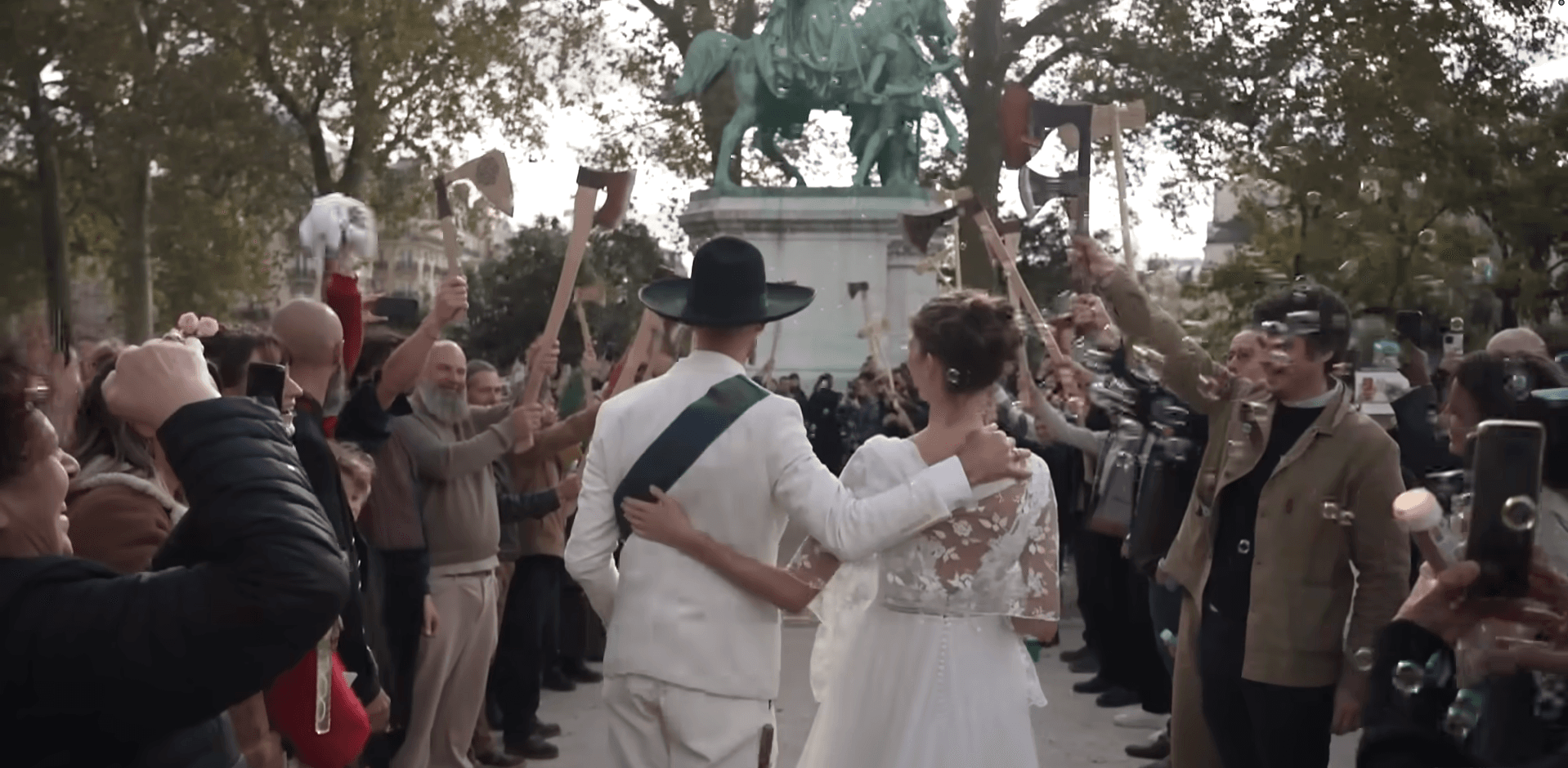
The groom was Martin Lorentz, a French carpenter who had spent three years rebuilding the cathedral's medieval timber framework after the fire, shaping oak beams with hand axes the way it had been done in the 1160s. The bride was his fiancée, Jade.
Notre Dame is not a parish church. Private weddings there are essentially never permitted. The Archbishop of Paris, Laurent Ulrich, granted an extraordinary exception — in recognition, his office said, of what Martin had given to the cathedral.
During the ceremony, the rector greeted them: "Jade and Martin, welcome to this cathedral. Martin — you know it well. You knew it from above, and now you're down here."
Five hundred guests attended. Many of them were carpenters who had worked on the restoration alongside Martin. As the newlyweds left the cathedral, his fellow carpenters formed an honour guard at the door, raised their axes in salute, and the tourists outside burst into applause.
A man who helped rebuild Notre Dame got married inside Notre Dame. And the building applauded back.
Things Most Tourists Miss
Even after you've stood in front of the facade and looked up at the towers, there are details around Notre Dame that almost no visitor notices. These are the moments I always point out on my tours.
Frequently Asked Questions
When was Notre Dame Paris built?
Construction began in 1163 under Bishop Maurice de Sully. The main structure was largely complete by 1260, with modifications and chapels continuing until around 1345. Many of the features visitors recognise today — the spire, the chimeras, the kings' statues on the facade — are 19th-century additions or replacements by Eugène Viollet-le-Duc during the 1844–1864 restoration.
What is Notre Dame Paris famous for?
Notre Dame Paris is one of the finest examples of French Gothic architecture in the world. It is famous for its early use of flying buttresses, its three medieval rose windows, its two iconic west towers, its association with Victor Hugo's novel The Hunchback of Notre-Dame, the coronation of Napoleon in 1804, and the 2019 fire and subsequent five-year restoration. It is also the official geographic centre of Paris.
Did Notre Dame really go on sale during the French Revolution?
Yes. In 1789 the Revolution seized all church property as national property. Notre Dame was sold at auction during the 1790s to a building-materials merchant who planned to strip the building for stone, lead, and timber. The sale was annulled by Napoleon Bonaparte through the Concordat of 1801, finalised on April 18, 1802. The phrase "PROPRIÉTÉ NATIONALE À VENDRE" — National Property for Sale — was still visible on the cathedral's facade as late as 1833.
Who saved Notre Dame in the 19th century?
Victor Hugo's 1831 novel Notre-Dame de Paris (published in English as The Hunchback of Notre-Dame) saved Notre Dame from a second demolition threat. After the July Revolution of 1830, rioters had damaged the cathedral and Parisian authorities had begun discussing complete demolition. Hugo's novel created a national movement to preserve the cathedral. The full restoration, led by Eugène Viollet-le-Duc, began in 1844 and continued for twenty years.
What caused the 2019 Notre Dame fire?
Investigators concluded the fire was started either by a discarded cigarette or by an electrical short circuit linked to the renovation work that was underway on the spire. The exact cause has never been definitively determined. The fire began at 6:18 p.m. on April 15, 2019, in the wooden attic structure known as la forêt.
Is Notre Dame Paris open to visitors now?
Yes. Notre Dame Paris reopened to the public on December 8, 2024, after a five-year restoration following the 2019 fire. Entry to the cathedral is free. A free timed-entry reservation is highly recommended during high-demand periods and can be made online via the official Notre Dame website. The tower climb and the archaeological crypt are separate ticketed experiences.
How much did it cost to rebuild Notre Dame?
The restoration cost approximately €700 million (around $750 million USD). The funds were raised through donations from more than 340,000 individuals and businesses across 150 countries. The three largest French luxury families — Arnault (LVMH), Pinault (Kering), and Bettencourt-Meyers (L'Oréal) — collectively pledged over €500 million.
Visit Notre Dame With Us
Most of the stories above I tell on our Notre Dame tours. The cathedral is free to enter, but the stories inside it — the headless kings, the bell that escaped the cannon, the rooster carrying three relics, the carpenter who got married in the building he rebuilt — are not in any guidebook.
If you want to walk Notre Dame the way I would walk it with a friend visiting Paris for the first time, that's what we do at Scenic Zest Tours.
→Book a Notre Dame guided tour with us — small groups, real stories, the version most tourists miss.


